DOTmed.com
New and Used Medical Equipment For Sale and Wanted
We don't own it... We help you sell it.
My DOTmed
Login | Register
The Medical Industry
Business Weekly
May 08, 2008

Other Headlines

DOTmed was first to break the news late last week that GE's OEC division was given the green light to re-start production; GE says more than 300 OEC® 9900 Elite C-arms are slated to ship within the first 10 days as they start to fill back-orders.
Quinn succeeds Jim Reid-Anderson, who has been named new CEO of Siemens Healthcare.
Account rep Grant Norris is DOTmed Certified.
Normally, three's a crowd. But the trifecta of OEMs, refurbishers and broker/dealers is the engine that's driving the medical trailer business.
Online marketplace for new and used medical equipment reaches another milestone.

Have News for Us?

Submit your news on the industry, people, or companies.

Forward to a Friend

More Industry Headlines

OEC Re-Certified by FDA -- Latest Update DOTmed was first to break the news late last week that GE's OEC division was given the green light to re-start production; GE says more than 300 OEC® 9900 Elite C-arms are slated to ship within the first 10 days as they start to fill back-orders.

SNM Annual Meeting Just About a Month Away The Society of Nuclear Medicine -- SNM -- holds its Annual Meeting this June 14-18 in New Orleans, LA. Exhibitors: You can still get a booth if you hurry!

Medicare Expands Coverage for Artificial Heart Devices Decision opens access to advanced technology.

GE Healthcare Introduces New 3.0T MR Scanner Breakthrough technology with simple design provides radiologists with powerful applications for increased clinical capability.

Get Your Bid in Now on This GE Signa MR/i Hispeed Plus MRI Scanner -- Just Posted on DOTmed! Also see the other great lasers, imaging systems, and more... all on your favorite website for used medical equipment!

Manufacturer of Heart Defibrillator Signs Consent Decree of Permanent Injunction Device manufacturer Physio-Control, Inc., its parent company Medtronic, Inc., and their two top executives have signed a consent decree of permanent injunction related to Automatic External Defibrillators.

Legislative Work Continues on Revamping FDA Congress, Agency say more funding is needed to improve safety.

Healthcare Experts to Address Medical Technology Executives at Annual Conference Medical device industry leaders and key healthcare subject matter experts will meet in Washington, DC for the 2008 Annual Meeting of the Medical Device Manufacturers Association (MDMA).

Cosmetic Soft-Tissue Filler Injections Linked to Cases of Acute Renal Failure Investigation finds adverse effects from non-medically supervised procedures.

Wolters Kluwer Health & Johns Hopkins Launch The Patient First journal dedicated to using scientific methods for patient-centric research.

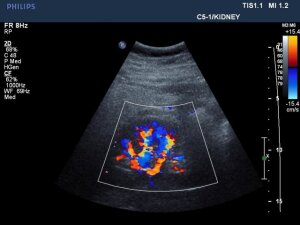
Kidney bloodflow visualized
by Philips' C5-1 ultrasound
probe technology

Philips Offers Improved Ultrasound for Obese Patients

by Barbara Kram, Editor
The rising prevalence of obesity in the U.S. and globally has challenged ultrasound systems to penetrate fatty tissue more effectively to obtain diagnostic views. Up to half of all abdominal ultrasound exams are conducted on large patients.

Fortunately, this technical challenge coincides with some cutting-edge R&D from Philips to develop a new type of crystal that can penetrate fatty tissue to reveal pathology beneath.

It's helpful to understand that ultrasound transducers use a piezoelectric material to deliver the ultrasound energy to the scanned tissue and convert resulting echoes into electrical signals. However, today's widely used crystal type, known as PZT, has its limitations, achieving only about 70% efficiency. A better type of piezocrystal has been discovered but has proven difficult to grow. Philips engineers have been working on this problem and made recent breakthroughs in both crystal growth and crystal properties. The result is a crystal technology they call PureWave, which are purer and more uniform crystals that can transfer energy with greater precision and efficiency. This material supports improved penetration in difficult patients, and excellent detail of the heart's fine structures. The technology can also be used in imaging other organs.

The Philips technologies that tap this innovation include the iU22 ultrasound system with the C5-1 transducer. Features of the system include tissue aberration correction and a functionality known as coded beamforming to reduce image degradation.

The chief challenge with obese patients is that their livers and other abdominal organs are more than 5 centimeters deep; the prevalence of fat and fatty livers are difficult to characterize. Using conventional ultrasound technology, it takes longer to perform the imaging study on difficult patients and they are ergonomically difficult for sonographers to manipulate. The image itself is degraded by changes in sound wave transmission through fat so the image loses resolution.

"We are seeing in our practice that obesity is increasing and there is also a rise in fatty livers, which is related to alcohol. However ultrasound has difficulty penetrating fat because it acts like fog to ultrasound," explained Simon Elliott, MD, radiologist at the Freeman Hospital in Newcastle, UK, who first began testing the device last year. "It is just like shining a torch [flashlight] into fog. You often cannot see organs and if you can see them it may still be difficult to make a diagnosis."


Philips has reduced the beam aberration problem. The C5-1 transducer accommodates the change in speed of sound waves as they move through adipose layers. In a sense the technology is "aware" of the effect of fat on sound waves and uses correction algorithms to provide a sharp image.

"Coded beamforming allows Philips to send more energy into the body without sacrificing axial resolution, all while staying within regulated acoustic power limits," explained Jim Walchenbach, Ultrasound Market Manager, Global Sales & Service/International, Philips Healthcare. This is accomplished by transmitting a longer, lower amplitude pulse than usual. This longer pulse is "coded" or given a recognizable shape. "This coded pulse is then sent into the body and the signal that returns is decoded to form a shorter effective pulse, thus preserving axial resolution. The overall effect of coded beamforming relative to our traditional beamforming is an image with more penetration while maintaining detail resolution."

The company conducted a study of the new ultrasound technology at six sites in North America and Europe and found it vastly reduced exam times and sonographer burden, while improving color sensitivity and reducing the need for additional studies in other modalities.


Please Send us your Comments.

Access and use of this site is subject to the terms and conditions of our LEGAL NOTICE & PRIVACY NOTICE
Property of and Proprietary to DOTmed.com, Inc.
Copyright ©2001-2008 DOTmed.com, Inc.
ALL RIGHTS RESERVED