HIMSS Estimates Increased Health IT Adoption
by
Kathy Mahdoubi, Senior Correspondent | April 13, 2009
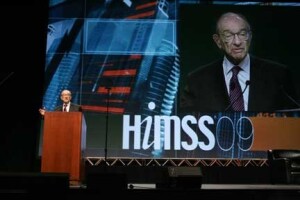
Alan Greenspan gives keynote speech at 2009 HIMSS
The Healthcare Information and Management Systems Society hosted approximately 27,500 attendees and more than 300 informative events for the 2009 HIMSS Conference and Exhibition, which took place April 4-8 at Chicago's McCormick Place Convention Center.
This year's conference was alive with speculation on the heels of the Feb 17 signing of the ARRA, which promises close to $20 billion for health care information technology programs. It was apparent to both vendors and heads of health IT organizations that the industry was on the verge of a major improvement in health care IT implementation, despite obvious economic constraints.
"Year after year, the HIMSS Conference & Exhibition allows hospitals and physician practices to explore and interact with electronic medical record applications and other IT solutions and equips them with the knowledge to use these products in meaningful ways," noted H. Stephen Lieber, President and CEO of HIMSS. "Now more than ever, providers are realizing the value of an electronic healthcare system and are moving toward implementing these technologies."
On the last day of the conference, Alan Greenspan, renowned financial analyst and former Chairman of the Federal Reserve Board, spoke about an "easing" of the economy, but also of troubled times ahead due to strains on the Medicare system and the health care industry at large. One of the greatest concerns was the need to confront the system's inability to hold up to rising costs and general inundation from an aging baby boomer generation. Health care information technologies, he said, could potentially help alleviate some of that tension.
Actor Dennis Quaid, cofounder of the Quaid Foundation for patient safety, was the conference's opening speaker. The Quaid Foundation was established after the Quaids' twins were administered an overdose of Heparin, a blood thinner, while hospitalized due to infection. Also on the key-note roster was George C. Halvorson, Chairman and CEO of Kaiser Foundation Health Plan, Inc. and Kaiser Foundation Hospitals. Halvorson is the lauded champion of a multi-billion dollar information technology initiative, dubbed KP HealthConnect, which was launched in 2008 and provides some 13,000 physicians electronic access to patient records across 400 medical offices.
DOTmed recently reported EMR implementation to be relatively low, according to a recent statistic from the New England Journal of Medicine. It was estimated that only two percent of U.S. hospitals have fully functional EMR systems. As one would expect, the HIMSS Leadership Survey shows implementation in a more progressive light. Of the 304 Health IT executives who responded, 41 percent said at least one of their facilities has a fully functioning EMR, which has increased from the 32 percent indicated in 2007.