A new method predicts the success of in vitro fertilization
by
Olga Deshchenko, DOTmed News Reporter | July 21, 2010
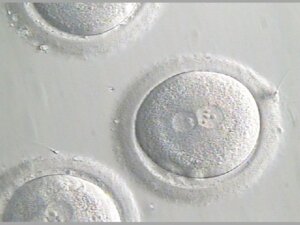
A human embryo that
was fertilized by IVF
(Courtesy of Dr. B. Behr and the
Clinical Embryology Laboratory
at the Stanford IVF Clinic)
A novel method can help predict with 70 percent accuracy whether a woman undergoing in vitro fertilization (IVF) treatment for the second time will become pregnant, a new study found.
Researchers at the Stanford University School of Medicine identified four factors that determine a woman's chances of getting pregnant from an IVF cycle. Dr. Mylene Yao, an assistant professor of obstetrics and gynecology at the university, led the research.
"We developed this prediction tool to provide high quality, personalized information that women and their physicians could use to support their decision-making in IVF," Yao wrote in an e-mail to DOTmed News. "This prediction tool also paves the way towards research that will help us better understand mechanisms of infertility."
During an IVF treatment, a woman is given drugs to stimulate ovulation. Her eggs are then removed from the ovaries and combined with sperm in a culture dish. Doctors then use a variety of criteria to determine which embryos produced in the IVF cycle are most likely to result in a live birth. However, the factors doctors take into consideration are not personalized.
According to the Society for Assisted Reproductive Technology, IVF cycles result in pregnancy for women using their own eggs about 18 to 45 percent of the time, depending on age and other variables.
Yao and her team of researchers analyzed clinical data from 665 IVF cycles performed at Stanford in 2005. They examined 30 different variables and looked at the connection of each variable with the IVF outcome. The researchers found that four factors were most important in determining a woman's chance of becoming pregnant through an IVF cycle: total number of embryos, number of eight-cell embryos, percentage of embryos that stopped dividing and would die, and the woman's follicle-stimulating hormone level (a measurement that estimates ovarian function).
Yao said the new method has a lot of implications for women trying to decide to go through a second IVF treatment.
"First, the ability to use information from the first IVF treatment to predict outcomes in subsequent cycles may cause the first IVF treatment to be viewed as a prediction test, in addition to being a treatment," Yao said. "The availability of personalized information may encourage more women to take at least one IVF treatment."
Yao also said patients who may decide to drop out after the first failed treatment can make a more informed decision about continuing with further IVF treatments.
"Results pertaining to the relative influence of each factor with respect to outcome prediction will also form new paradigms for thinking about the causes for IVF, and how to develop treatments that will target specific mechanisms," said Yao.
Yao and her collaborator, Wing Wong, have founded a company together called Univfy Inc. to develop and market the new method, she said.
"We hope to make this technology accessible to patients and physicians nationwide, subject to FDA clearance," Yao said.