Proton therapy to remain an exclusive club
by
Brendon Nafziger, DOTmed News Associate Editor | February 24, 2011
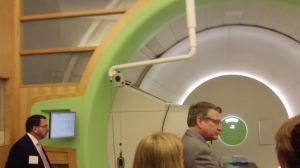
A treatment room at
the Roberts Proton
Therapy Center in
Philadelphia
The United States will see no more than 20 or 30 proton therapy centers over the next decade, and the capital costs to build them have shot up over time, were the take-home findings of a recent conference on proton therapy. And to succeed, proton therapy centers should think carefully about marketing.
"Proton therapy needs to be looked at as a retail service," Alan E. Morrison, managing director of ZAC Capital Partners LLC, told attendees.
The Proton Therapy Centers conference, which met from Feb. 16-18 in Philadelphia at the Sofitel Hotel, is a gathering for the people who run or want to run one of the most advanced, and expensive, medical technologies on the planet.
It's a rather intimate meeting, occupying a handful of rooms on a single hotel floor, with many of the attendees old acquaintances. Between the more than dozen or so talks and workshops, they spent time catching up and swapping gossip.
It's a small world -- there are only nine proton therapy centers in the United States, with about 21 centers worldwide and an additional eight under development, according to reports given at the meeting. Globally, that breaks down to about 97 treatment rooms.
Only about six companies make the massive cyclotrons and synchrotrons that power the treatment. The market leader is Belgium-based Ion Beam Applications S.A., which accounts for 60 percent of the world market and has installed its cyclotrons in all but two of the working therapeutic sites in the United States. The exceptions are M.D. Anderson Cancer Center in Houston, which uses a Hitachi-built synchrotron, and Loma Linda University Medical Center in California, the first center to treat patients, in 1990, which uses a system built by Fermilab scientists.
The proton therapy world is small largely because of the high cost of entry, with the total price tag for building and getting a center up and running estimated to fall between $180 million to $240 million, according to Morrison's calculations.
But the therapy, which uses high-energy protons to eradicate cancer, allows more precise radiation dosage than traditional radiation therapy. This is generally thought to be most beneficial for pediatric patients with complicated brain or spine tumors, and for whom limiting radiation dose is critical. And some studies -- including one published earlier this month -- hint that it might also help curb side effects of radiation treatment for prostate cancer patients, who make up the bulk of people treated by this modality.
However, despite being attractive for hospitals, it's hard to raise the capital necessary to see the projects off the ground. Many more are announced than ever see the light, similar to "vaporware" -- computer programs that exist only in their initial, feverish publicity. "There are a lot of press release projects," Morrison quipped.
|
|
|
You Must Be Logged In To Post A Comment
|










Dave Dickey
Homework on Proton Beam system suppliers not done!
February 24, 2011 03:15
There are other companies that are developing less costly proton treatment systems, which were not mentioned in this article. At McLaren Health Care in Michigan, we are due to receive our system from Protom International, Inc., this summer, for a three gantry room configuration. Our project cost is less than half the cost of what was identified in the article. For our site, half the shielding is needed from what has historically been required, further reducing the cost of PBT, and our total time for construction and equipment installation is projected to be 14-16 months, far less than industry standard.
to rate and post a comment